
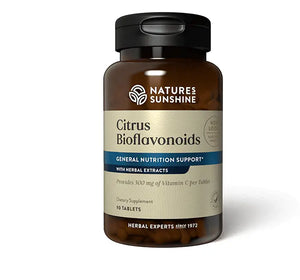


Aiding in the creation of hormones, collagen, enzymes and proteins, bioflavinoids help protect your health while doing amazing work!
- Supports the immune system
- Protects against free-radical damage
HOW IT WORKS
Vitamin C performs many functions involving the immune system and tissue development. It is involved in iron absorption and in the syntheses of enzymes, hormones and proteins. The adrenal glands need large amounts of this nutrient in order to support immunity and help produce energy. Vitamin C is easily washed from the body and needs to be replaced constantly. Without vitamin C, the body cannot make collagen, the substance that holds the body’s cells together and maintains skin integrity. Vitamin C works best with attending bioflavonoids, which help protect the body from free radical damage.
THE STORY BEHIND CITRUS BIOFLAVONOIDS
In the 1930s, Hungarian chemist Albert Szent-Györgyi discovered and named ascorbic acid (vitamin C), which literally means “anti-scurvy.” In 1936, he found a group of bioflavonoid compounds that he named vitamin P. He won the Nobel Prize for Medicine in 1937 for his discoveries and for his description of the oxidation process. American biochemist and two-time Nobel Prize winner Linus Pauling studied scientific literature on vitamin C and became a true advocate for this nutrient, penning Vitamin C and the Common Cold in 1970. Grapefruit is native to Barbados and was popular in the West Indies before it was more widely known. Lemons are likely native to China and perhaps Burma. The orange tree, now one of the most cultivated in the world, can be traced to the 4th century in China! Rose plants grow globally in the northern hemisphere. Native North Americans ate rose hips in the wild as a dietary staple. During World War II, when citrus fruit was scarce, Britons gathered rose hips and made them into syrup to nourish children.
THE STORY BEHIND VITAMIN C CITRUS BIOFLAVONOIDS
In the 1930s, Hungarian chemist Albert Szent-Györgyi discovered and named ascorbic acid (vitamin C), which literally means “anti-scurvy.” In 1936, he found a group of bioflavonoid compounds that he named vitamin P. He won the Nobel Prize for Medicine in 1937 for his discoveries and for his description of the oxidation process. American biochemist and two-time Nobel Prize winner Linus Pauling studied scientific literature on vitamin C and became a true advocate for this nutrient, penning Vitamin C and the Common Cold in 1970. Grapefruit is native to Barbados and was popular in the West Indies before it was more widely known. Lemons are likely native to China and perhaps Burma. The orange tree, now one of the most cultivated in the world, can be traced to the 4th century in China! Rose plants grow globally in the northern hemisphere. Native North Americans ate rose hips in the wild as a dietary staple. During World War II, when citrus fruit was scarce, Britons gathered rose hips and made them into syrup to nourish children.
RECOMMENDED USE
Take 2 tablets daily with a meal
INGREDIENTS
500 mg Vitamin C per tablet (835% of the Daily Value), calcium, phosphorus, grapefruit bioflavonoid extract, hesperidin, lemon bioflavonoid extract, orange bioflavonoid extract, rutin and rose hips.

